

 Sep 10, 2026 | 4 minute read
 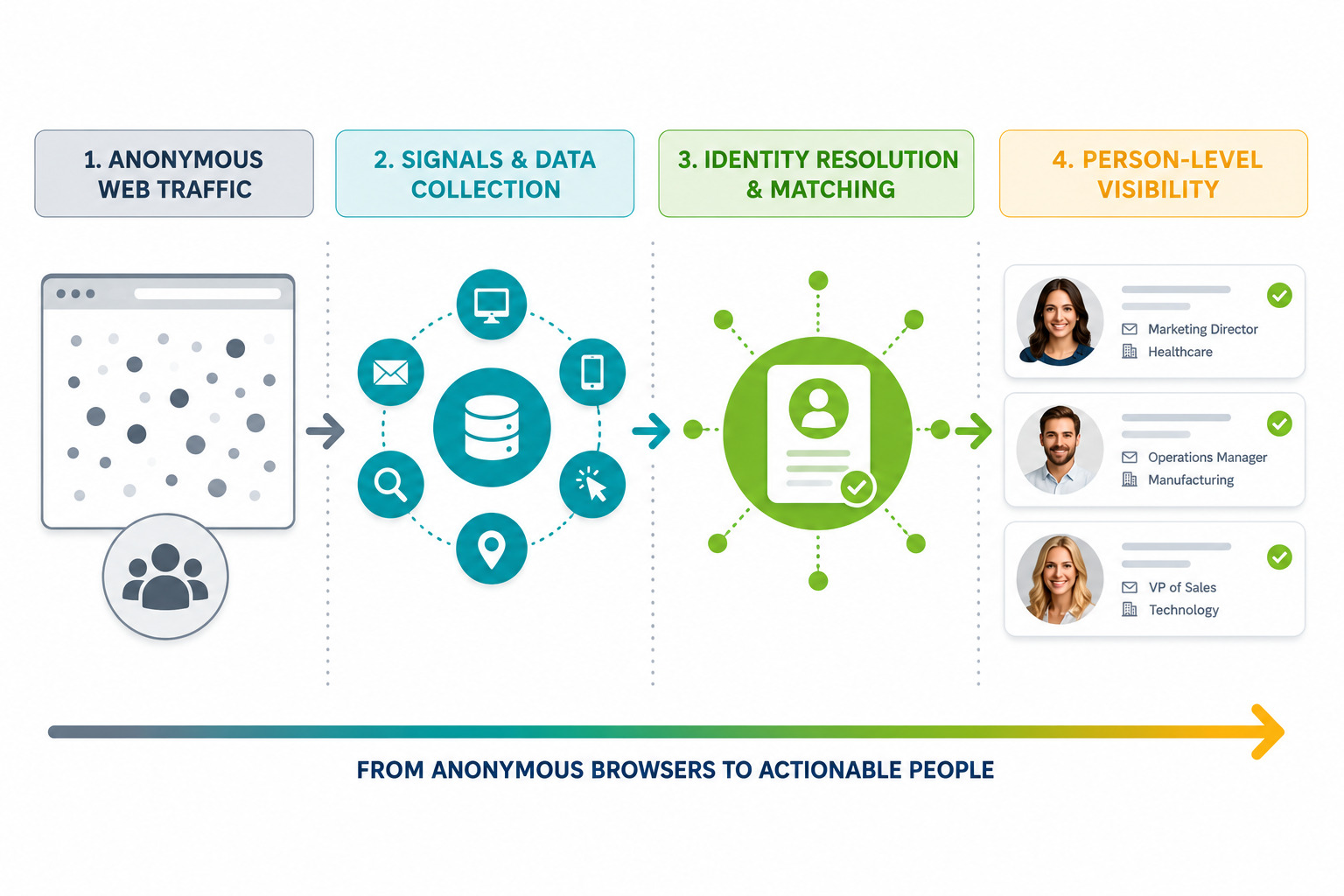 An identity-first marketing strategy is not just a technology upgrade. It is a strategic shift in how teams recognize buyers, activate audiences, personalize engagement, and measure performance. Instead of depending mainly on anonymous browser signals, identity-first marketing organizes campaigns around connected knowledge of real people and real accounts.
For marketing leaders, the goal is straightforward: improve efficiency and accountability by making the buyer journey more visible and more actionable. That means identifying meaningful visitors, connecting behavior to source and fit, and making it easier for sales and marketing to act on the same signals.
Start with the Right Identity Foundation
Every identity-first strategy begins with the data and systems that define recognition. If your website, CRM, ad platforms, and email tools all contain fragments of the same buyer journey but none of them connect reliably, your strategy will remain limited. The first step is to establish how identities are collected, resolved, enriched, governed, and activated.
This requires a practical review of several elements:
- What identifiers are currently available across web, CRM, and marketing systems.
- How those identifiers are matched and whether the logic is high-confidence enough for activation.
- What enrichment is needed to make records useful for segmentation, scoring, and outreach.
- What privacy, suppression, and consent requirements need to be enforced consistently.
Without this foundation, teams often end up with identity data that exists in theory but is too incomplete or inconsistent to drive better execution.
Align Identity to Use Cases, Not Just Data Collection
One of the most common mistakes in identity planning is treating identity as a data project rather than a performance project. The right question is not only what data can be collected. The right question is what business outcomes that identity should improve.
For most marketing teams, the strongest use cases include:
- Identifying high-intent website visitors who never fill out a form.
- Improving paid media efficiency with person-level audience activation.
- Enriching inbound and anonymous engagement with firmographic or demographic detail.
- Routing better-qualified opportunities to sales faster.
- Improving attribution by connecting campaign source data to known pipeline activity.
When the strategy is tied to use cases like these, it becomes easier to prioritize integrations, workflows, and measurement criteria that actually matter.
Build Activation Into the Plan
An identity-first strategy only creates value when the identity data is usable in downstream systems. That means activation should be planned from the beginning, not treated as a later optimization. Activation may include:
- CRM sync
- Ad audience creation
- Email nurture
- Suppression updates
- Routing rules
- Lead scoring
- Automated alerts to sales
In each case, the purpose is the same: make sure identity signals improve decisions and speed up action rather than sitting inside a dashboard.
Measure What Identity Changes
A mature identity-first strategy should be measured against outcomes that matter to revenue teams. Vanity metrics do not disappear, but they should no longer be the center of the story. Instead, teams should evaluate whether identity improves lead quality, targeting precision, audience efficiency, sales responsiveness, and revenue attribution.
A useful measurement framework often includes:
- Match rate or identifiable visitor coverage, where relevant to the solution.
- Qualified lead volume created from previously anonymous traffic.
- Audience performance improvements from more precise targeting.
- Speed-to-lead improvements based on faster surfacing of high-intent activity.
- Pipeline and revenue influence tied to known campaigns and known buyers.
Identity should not be measured as an abstract capability. It should be measured by whether it improves the business outcomes your team is accountable for.
Make Privacy and Governance Part of the Strategy
Strong identity programs require strong governance. Consent-aware practices, suppression controls, opt-out handling, and clear data stewardship are not side considerations. They are part of what makes the strategy scalable and defensible.
At Visual Visitor, our platform includes mechanisms such as suppression lists, legal do-not-track controls, known customer filtering, cookie consent tools, and compliant email practices. Teams that incorporate these controls from the beginning are better positioned to build long-term performance without avoidable legal or reputational risk.
Final Thoughts
If your team is ready to build a more accountable, identity-first marketing engine, speak with a product specialist at Visual Visitor. A stronger identity strategy can help you uncover hidden demand, improve audience precision, and turn more website engagement into real pipeline.
FAQ
Q: What is an identity-first marketing strategy?
A: It is a marketing strategy that prioritizes recognition of real people and accounts across channels so campaigns, personalization, and measurement can be more accurate and actionable.
Q: What are the first steps in building an identity-first marketing strategy?
A: Start by auditing your identity sources, resolution logic, activation workflows, and governance controls across web, CRM, and marketing systems.
Q: Why is activation important in an identity-first strategy?
A: Because identity data only creates value when it is pushed into the systems and workflows that drive campaigns, lead routing, sales outreach, and Q: reporting.
Q: What metrics should marketers use?
A: Use metrics tied to coverage, lead quality, audience performance, speed to lead, and pipeline influence instead of relying only on traffic and click data.
Q: Does identity-first marketing help B2B and B2C teams?
A: Yes. The applications differ, but both benefit from stronger recognition, enrichment, audience precision, and measurement.
Q: How can Visual Visitor support this strategy?
A: Visual Visitor helps identify visitors, enrich records, activate audiences, manage suppression, and connect buyer activity to practical marketing and sales workflows.