
 Every tactic you run to drive traffic ends the same way. Someone lands on your site, browses a few pages, and leaves. You spent money to get them there. You have no idea who they were.
That is not a content problem or a design problem. It is an infrastructure problem. Most interactions on the web are anonymous by default, and no amount of retargeting pixels or form optimization changes that underlying reality. What changes it is an identity graph.
Let’s look at what an identity graph is and how one is built. It also covers how we, at Visual Visitor, use ours to connect anonymous visitors to real, reachable people.
What Is an Identity Graph?
An identity graph is a database that links multiple identifiers to a single real-world person. Those identifiers can include:
- Email addresses
- Device IDs
- Mobile ad IDs (MAIDs)
- Phone numbers
- Cookie IDs
- IP addresses
- Hashed identifiers
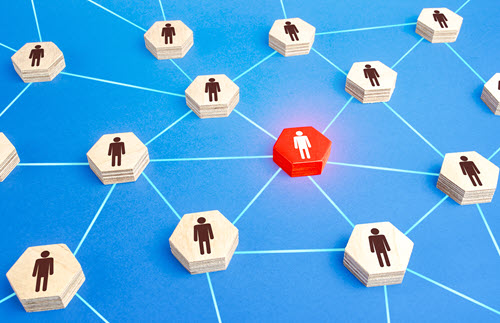
Think of it like a contact record that never stops updating. Each time a new signal is associated with a known identity, the graph connects it. The result is a unified profile that represents one real individual across every device, channel, and touchpoint they use.
Without a graph like this, a visit from a desktop browser and a visit from a mobile phone look like two separate, anonymous people. With the graph, they resolve to the same person. That resolution is what makes visitor identification possible.
What Goes Into an Identity Graph?
Building a reliable identity graph requires pulling from a wide range of data sources. The more sources you have, the more complete and accurate each profile becomes.
Our graph is fed by a wide range of sources. These include:
- Data co-ops
- Social channels
- Publishers
- Technology platforms
- Research firms
- Event firms
We also pull from review sites, publishing networks, advertising signals, job postings, search engine results, tracking pixels, and email signals.
Each source adds a different layer of identity data. Social channels contribute demographic and behavioral signals. Job postings and search results add professional context. The tracking pixel and email signals tie known identities to real website activity.
All of these signals are continuously processed and matched. We process 20 TB of data every month, and the graph is updated daily. We also maintain 16 billion IP address to MAID mappings, which is the foundation for connecting desktop and mobile activity to a single individual.
No single source can build a complete picture. The value comes from combining them.
How Matching Works
The two core identifiers that power our matching are hashed email addresses (HEMs) and mobile ad IDs (MAIDs).
A hashed email address is created by running an email address through a one-way cryptographic transformation. The result is a fixed-length string that cannot be reversed into the original email. Two parties can still match on it because the same email always produces the same hash. This allows identity resolution without ever exposing raw personal data.
A mobile ad ID is a device-level identifier assigned by mobile operating systems. It is used for ad targeting and identity resolution across apps and the mobile web. When someone browses on their phone, their MAID is one of the signals that ties that session to a known individual.
Together, HEMs and MAIDs allow the graph to connect an anonymous website visit to a real person. This works without relying on third-party cookies and without compromising individual privacy.
Why Size and Freshness Matter
Not all identity graphs are the same. The size, quality, and freshness of the graph determine how high the match rate can be. A small graph produces low match rates. A stale graph produces outdated contacts.
Our consumer database contains 900 million or more consent-based contacts. Our U.S. B2B database contains 248 million or more contacts. Every single email address is fully validated before it is ever delivered.
Daily updates matter more than most people realize. In B2B specifically, roughly 33% of email addresses change every year. People change jobs, get promoted, and/or move companies. A graph that is not refreshed consistently will return contacts that no longer exist at those addresses. That wastes outreach budget and harms deliverability.
Freshness is not a nice-to-have. It is a core quality signal.
How Visual Visitor Puts the Identity Graph to Work
The identity graph is the engine. Our products are what you see on the surface.
WebID +Person uses the graph to identify anonymous consumer visitors in real time. It matches them against our 900+ million consent-based contact database via a lightweight tracking script. It returns the visitor's name, verified email, demographics, social profiles when available, traffic source, visit history, and behavioral signals. We can identify up to 50% of anonymous U.S. visitors. Without this, 98% of visitors leave your site without a trace.
WebID +Employee resolves B2B visitors to the specific individual employee, not just the company. Standard reverse-IP tools identify the company. Our graph identifies the person. This matters because more than 40% of B2B buyers now work remotely. A remote worker visiting from a home IP address is invisible to reverse-IP. Our graph catches them because identification is built on MAIDs and HEMs, not on the IP address of a corporate office.
It returns name, validated work email, job title, seniority, company firmographics, behavioral data, pages visited, and traffic source.
Person-Level Advertising, also known as Contact-Level Advertising, takes a different approach entirely. Instead of waiting for visitors to come to you, Person-Level Advertising uses the identity graph proactively. It builds outbound audiences of named individuals who are already researching relevant topics.
You choose from 48,000+ intent topics, 38,000+ B2B and 10,000+ B2C. We build hashed-email audiences of real, named individuals who are actively researching those topics, and push those audiences to Google and Facebook. The result is identity-based targeting that does not depend on cookies. Our published data shows 40% or more conversion uplift compared to keyword bidding, lookalike audiences, and standard retargeting.
Privacy and Compliance
Identity graphs sometimes get framed as a privacy concern. The answer to that concern is not avoidance. It is consent.
Our graph is ethically sourced and consent-based. Every contact in our database has opted in. We are 100% compliant or aligned with CCPA, GDPR, and CAN-SPAM. Our platform includes built-in cookie consent banners. It auto-adapts to changing privacy regulations as they evolve. Opted-out contacts are suppressed automatically, so you never need to manually manage exclusion lists.
Consent-based identity is not a workaround or a legal hedge. It is the correct way to build an identification infrastructure. When the data is sourced ethically, everyone benefits: marketers get accurate information, and individuals retain control over how their data is used.
The Infrastructure Behind the Results
The identity graph is not a buzzword. It is the literal infrastructure that identification and advertising capabilities run on. Every name, email, and behavioral signal you get from a visitor identification platform is only as reliable as the graph behind it.
The quality of the graph determines the quality of the leads you get. A poorly maintained graph means missed visitors, wrong contacts, and wasted spend. A high-quality, consent-based, continuously updated graph means the opposite.
We have spent 15 or more years building and maintaining the data infrastructure behind Visual Visitor. More than 3,000 companies trust our platform. Our graph contains over 900 million consumer contacts and 248 million U.S. B2B contacts, mapped through 16 billion IP-to-MAID connections, processed and validated continuously.
If you want to see what visitor identification looks like when it is backed by infrastructure like this, we would be glad to show you. Try Visual Visitor and see how many of your anonymous visitors we can put a name to.