
 Third-party cookies are disappearing, buyer journeys are splintered across devices, and privacy expectations are rising. In that environment, knowing who is actually engaging with your brand has become mission-critical. Identity intelligence is how modern marketers connect those dots and turn disconnected signals into a single, reliable understanding of each customer and prospect.
At Visual Visitor, identity intelligence sits at the core of how we help B2B and B2C teams turn anonymous website visitors into sales-ready leads, segment audiences with confidence, and prove marketing ROI to the board. This article defines identity intelligence, explains why it matters, and shows how an identity-first mindset can reshape your marketing performance.
What is Identity Intelligence?
Industry leaders describe identity intelligence as the collection and analysis of data about individuals and entities to understand who they are, how they behave, and how they are connected. It goes beyond basic identity verification or a one-time match to create a living profile that adapts as new data arrives.
Across multiple reputable sources, several common elements emerge:
- Identity intelligence fuses signals from many systems and channels to build a single view of a person or account.
- It transforms fragmented data points into an adaptive profile that can inform risk decisions, personalization, and targeting.
- It is continuous, updating as users interact on new devices, sessions, and sites or as records change over time.
- It is action-oriented, designed to drive better business decisions, not just generate reports.
From a marketing perspective, identity intelligence is the engine behind identity-first strategies: it allows you to recognize real people rather than just devices or cookies, and to connect every interaction back to an actual buyer or account.
How Identity Intelligence Works (At a High Level)
While implementations vary, most identity intelligence programs follow a repeatable pattern described in modern identity resolution and analytics practices.
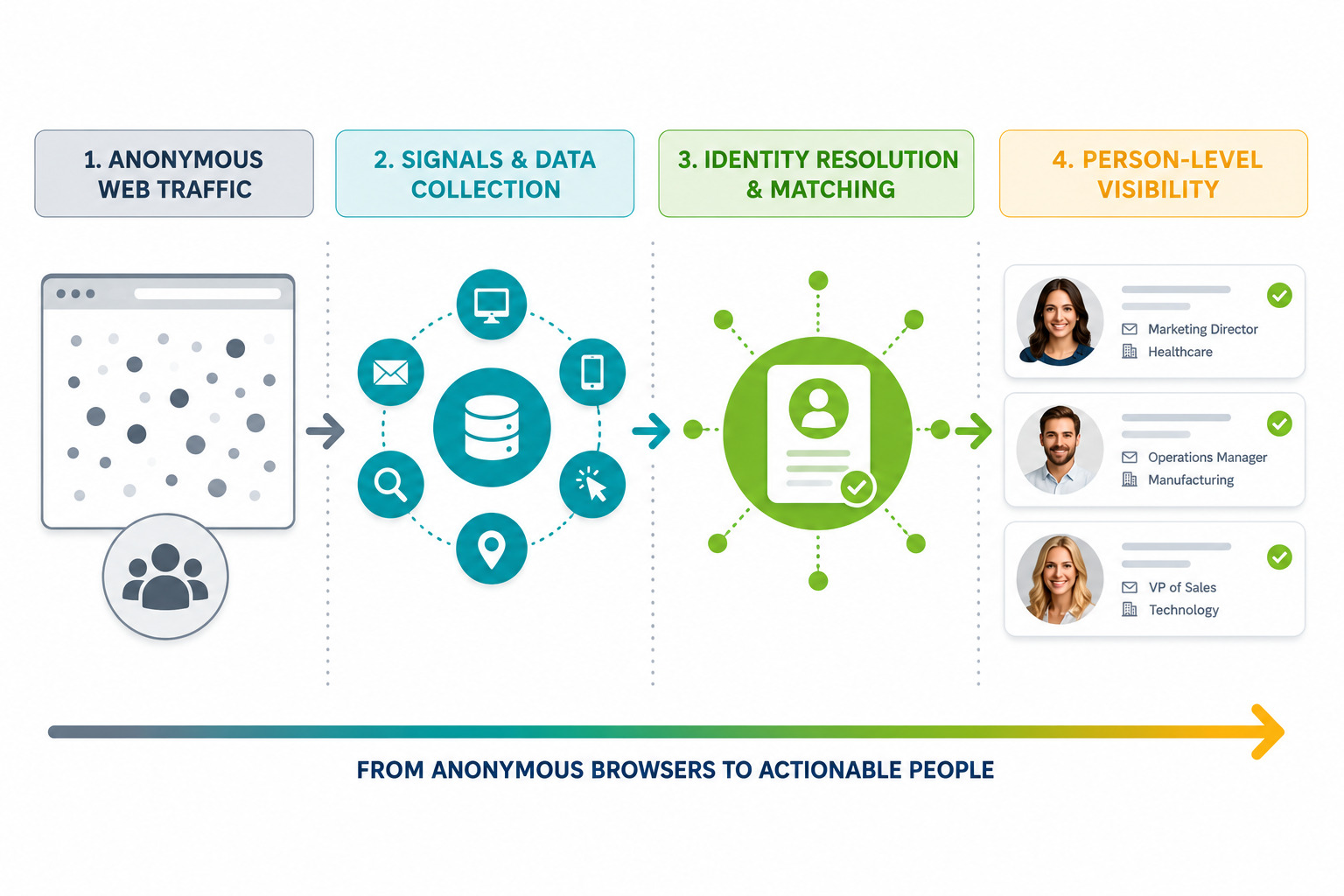
- Data collection across touchpoints
Organizations collect identifiers and behavioral signals from websites, apps, CRM systems, ad platforms, email tools, and offline sources. Common identifiers include email addresses, phone numbers, customer IDs, device IDs, and firmographic attributes in B2B contexts. - Data cleansing and normalization
Identity intelligence depends on clean, standardized data. Best-practice guidance emphasizes auditing for gaps, deduplicating records, and normalizing formats before applying matching logic. Poor data quality directly undermines match accuracy and downstream decisions. - Identity resolution and profile creation
Identity resolution is the process of linking these actions and attributes across devices, channels, and systems to a single profile. Deterministic identifiers (like validated email addresses) are used where possible, and probabilistic signals may supplement in some solutions. The result is a unified customer or account profile that consolidates behavior and context. - Enrichment and intelligence layers
Identity intelligence enhances profiles with additional attributes, risk indicators, or predictive scores, drawn from internal data, trusted external sources, or analytics models. These enriched profiles support more precise segmentation, personalization, and risk management. - Activation into marketing and sales workflows
Finally, unified profiles are activated: they feed audience building, person-level advertising, journey orchestration, lead scoring, and sales enablement. Identity intelligence becomes visible in day-to-day work when marketers can target “who” instead of just “what page” or “which device.”
Visual Visitor’s platform is designed around these principles: identify visitors at the person and company level, validate and enrich contact data, and make that intelligence usable in your marketing, sales, and CRM workflows.
Why Identity Intelligence Matters More Every Year
Industry data shows marketers are shifting toward first-party, identity-based strategies because traditional cookie-based approaches are losing reach and reliability. Several trends are driving the importance of identity intelligence.
- Cookie deprecation and tracking limits
Major browsers have restricted or announced phase-outs of third-party cookies, reducing the effectiveness of legacy retargeting and cross-site tracking. Without identity intelligence, it becomes harder to cap frequency, attribute conversions, and recognize repeat visitors. - Explosion of channels and devices
Customer journeys now span websites, mobile apps, social channels, email, and offline interactions. Identity resolution experts note that identity intelligence is how you connect these fragmented signals into a trustworthy view of each customer. - Privacy and compliance expectations
Regulatory guidance and industry best practices emphasize consent, clear disclosures, and secure handling of personal data. Identity intelligence frameworks must respect these requirements, integrating suppression lists, consent records, and ethical visitor identification practices. - Demand for precise attribution and ROI proof
Marketing leaders are under pressure to link spend directly to pipeline and revenue. Person-level reporting and identity-driven measurement enable marketers to attribute performance to real buyers and accounts, not just sessions and impressions.
Taken together, these trends explain why identity intelligence is moving from “advanced capability” to “marketing essential.” It is the practical way to keep recognizing and serving customers in a cookieless, multi-device, privacy-conscious world.
Identity Intelligence vs Traditional Data and Cookies
Identity intelligence offers a stronger foundation than traditional cookie-based tracking because it focuses on real people and accounts instead of temporary browser identifiers. Cookie-based approaches rely on third-party or pixel cookies that sit inside a specific browser or device, which means the connection breaks easily when someone clears cookies, switches devices, or changes environments. As a result, they tend to produce an anonymous, session-level view of behavior that tells you what happened on a screen but not who did it or whether that activity came from a desirable buyer.
Identity intelligence, by contrast, uses person-level signals such as validated email addresses, customer IDs, and other deterministic identifiers to build profiles that persist across visits, channels, and devices. Those profiles link behavior to real-world people or accounts, allowing you to see who is engaging, how often, through which sources, and with which content, instead of treating every interaction as a disconnected event.
From a privacy standpoint, identity-first strategies lean on first-party, consent-based data and explicit governance controls, rather than opaque cross-site tracking that depends on third-party cookies. That shift changes activation and measurement as well: where cookies primarily fuel standard retargeting and aggregate click metrics, identity intelligence enables person-level advertising, more precise audience building, and revenue reporting tied to known buyers, opportunities, and accounts.
How Visual Visitor Puts Identity Intelligence to Work
Visual Visitor’s platform is built to operationalize identity intelligence for marketers and sales teams, especially in environments where much of your website traffic has historically remained anonymous. Our capabilities include:
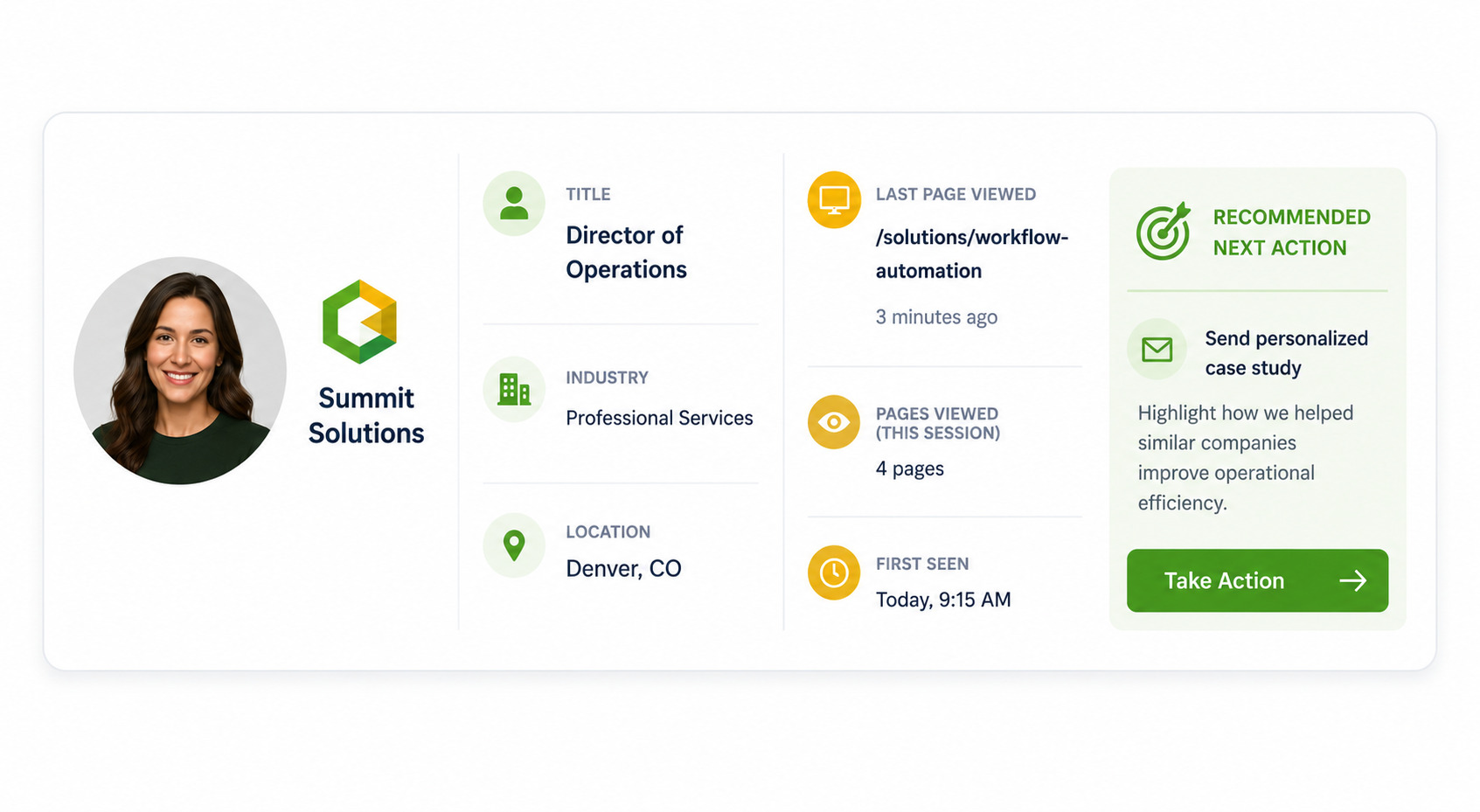
- Website visitor identification at person level. Visual Visitor can identify a portion of U.S.-based website visitors by first name, last name, email, and dozens of additional data points, transforming anonymous traffic into actionable leads.
- Identity resolution and enrichment for B2B and B2C. The platform associates visitors with companies, job titles, firmographics, and sometimes consumer demographic indicators, providing richer context for segmentation and sales outreach.
- Known customer and suppression management. Visual Visitor supports suppression lists and “Known Customers” logic so that existing customers, employees, vendors, and legally suppressed contacts are filtered appropriately.
- Person-level advertising and engagement. With person-level advertising and AI-driven nurturing, marketers can build custom audiences of identified visitors and deliver tailored messages that align with the pages viewed and time on site.
- Sales intelligence and AI coaching. Identity intelligence also powers sales workflows: sales teams receive detailed prospect profiles and AI-generated guidance on how to communicate with specific buyers based on their role and behavior.
Our goal is simple: give your marketing and sales teams a trusted identity layer so they can stop guessing who is behind each visit and start engaging real people with relevant, timely communication.
Practical Benefits for Marketers and Sales
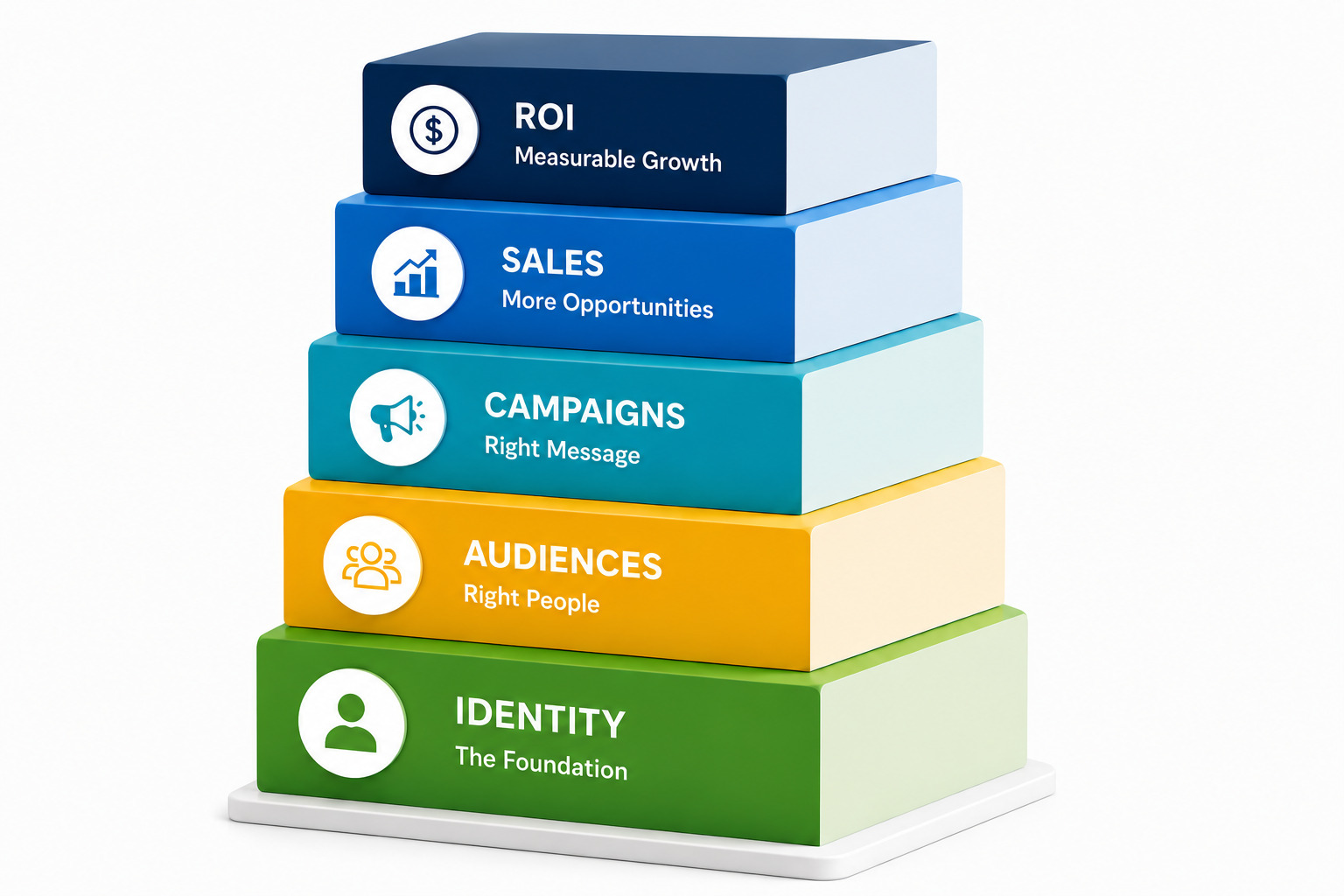
When identity intelligence is integrated into everyday operations, it reshapes performance across every stage of the funnel, not just at the point of conversion. At the top, identity-driven marketing allows you to attract and segment audiences based on real customer attributes and observed behavior rather than broad cookie-based cohorts, so awareness and consideration programs reach the right people more efficiently.
In the middle of the funnel, person-level identification enables more precise nurturing of lower-funnel visitors who have already shown intent. This typically improves conversion rates and reduces wasted spend on audiences that were never a strong fit.
Further down the funnel, identity intelligence helps align marketing and sales by giving sales teams context-rich profiles directly tied to marketing activity, making it easier to prioritize outreach, personalize conversations, and move qualified prospects forward faster.
On the measurement side, identity shifts optimization away from generic metrics toward outcomes such as qualified contacts, opportunities, and revenue tied to known buyers and accounts, which makes performance reporting more credible and actionable. For Visual Visitor customers, this combination means fewer unqualified leads, more sales-ready conversations, and a much clearer line from website traffic to booked revenue, because identity intelligence turns the data they already collect into decisions that move the business.
Final Thoughts
If you are ready to move beyond anonymous traffic reports and build a marketing engine powered by identity intelligence, our team at Visual Visitor is here to help. Our platform is designed to identify real people and companies behind your website visits, enrich those profiles with the context your sales and marketing teams need, and activate identity-first campaigns that drive measurable revenue.
Speak with a Visual Visitor product specialist today to see how identity intelligence can fit into your existing stack, strengthen your privacy posture, and unlock a new level of performance from every visitor who lands on your site. We’ll walk you through real examples from your traffic, discuss practical next steps, and help you build an identity-first strategy that’s tailored to your goals.
FAQ
Q. What is identity intelligence in marketing?
A. Identity intelligence in marketing is the practice of collecting and analyzing identity data to build unified, person-level profiles that drive targeting, personalization, and measurement. It links fragmented interactions across channels and devices to real people or accounts so teams can make better decisions with trusted data.
Q. How is identity intelligence different from identity resolution?
A. Identity resolution is a core process within identity intelligence: it matches identifiers and events to a single profile. Identity intelligence adds enrichment, risk or opportunity scoring, and activation workflows that turn those profiles into actionable insights for marketing, sales, and security teams.
Q. Why is identity intelligence important in a cookieless world?
A. As browsers limit third-party cookies and cross-site tracking, marketers lose many traditional tools for retargeting and attribution. Identity intelligence, based on first-party data and consent, provides a durable way to recognize customers, personalize experiences, and measure ROI even as cookies decline.
Q. Does identity intelligence require consent and privacy controls?
A. Reputable implementations of identity intelligence are grounded in consent, transparency, and compliant data handling. Platforms like Visual Visitor incorporate suppression lists, ethical visitor identification practices, and configurable filters so customers can align identity use with legal and policy requirements.
Q. How does Visual Visitor use identity intelligence to help sales teams?
A. Visual Visitor leverages identity intelligence to provide sales teams with detailed visitor profiles, including contact data, company information, and behavioral insights. AI-driven tools then use those profiles to recommend outreach strategies and help sales focus on the most engaged, qualified prospects.
Q. Can identity intelligence improve marketing ROI?
A. Yes. By tying website visits and campaign engagement to real people and companies, identity intelligence enables more precise targeting, better lead quality, and clearer attribution. Marketers can reduce spend on unqualified traffic and reinvest in channels and audiences that demonstrably drive revenue.
Q. Is identity intelligence useful for both B2B and B2C brands?
A. Identity intelligence applies in both B2B and B2C settings, though the attributes used differ. Visual Visitor supports identity-driven strategies for each by combining visitor identification with company-level and consumer-level data where applicable.
Q. How do I get started with identity intelligence?
A. Best practices suggest starting with a data audit, identifying key identifiers, and selecting an identity solution aligned to your use cases. Visual Visitor offers tools and guidance to help you implement website visitor identification, suppression controls, and person-level activation without having to build everything yourself.