
 Identity resolution is one of the most important capabilities in modern marketing because it answers a basic but difficult question: Who is actually behind the interactions happening across your digital channels?
Without a reliable way to connect those interactions, your systems may know what happened but still fail to understand who did it.
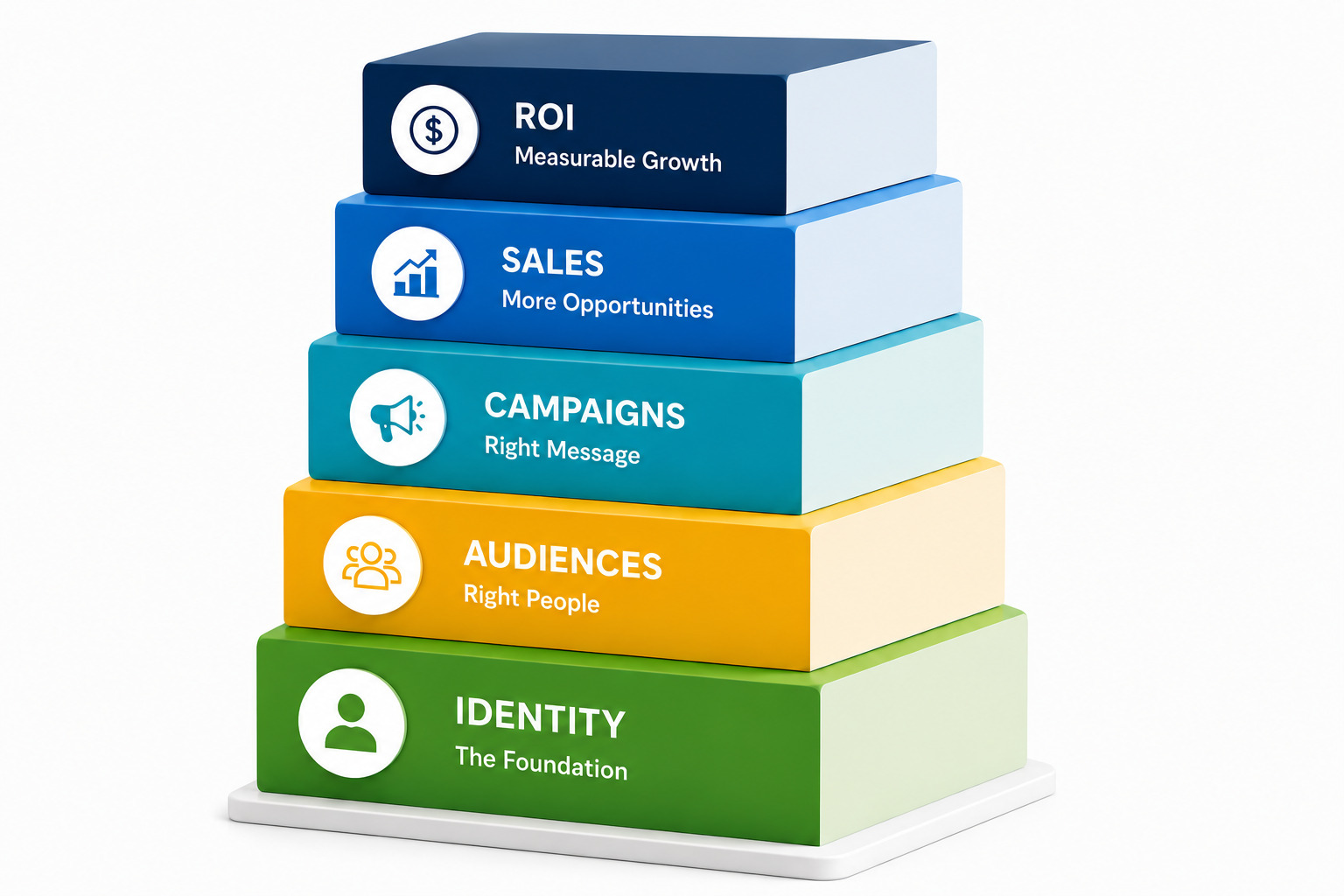
At Visual Visitor, identity resolution is foundational to website visitor identification, audience activation, and more informed sales follow-up. It is the process that makes an identity-first strategy operational, because it transforms fragmented signals into a usable profile that marketing and sales can act on with greater confidence.
What Is Identity Resolution?
Identity resolution is the process of connecting identifiers, attributes, and interactions from multiple sources to a single person or account profile. The process may use exact identifiers such as validated email addresses, phone numbers, or customer IDs, and it may also incorporate broader contextual signals depending on the system and use case.
The reason this matters is simple. People do not behave like database rows. A prospect might visit your site from a personal device, open an email on a work laptop, engage with an ad, and later speak with a sales rep from a corporate account. If those events remain disconnected, your targeting, reporting, and lead qualification all become less accurate.
Identity resolution is what gives structure to that chaos. It helps determine whether seemingly separate events should be connected and whether the result is trustworthy enough to activate.
How Identity Resolution Works
Although vendors use different architectures, the underlying process follows a recognizable pattern. First, systems collect identifiers and behavioral data from websites, CRM platforms, ad tools, email systems, and sometimes offline sources. Then that data is cleaned, normalized, and evaluated for match opportunities.
The matching stage can include several methods:
- Deterministic matching uses exact, verified identifiers such as a confirmed email address or validated login, which generally produces higher-confidence matches.
- Probabilistic matching uses statistical signals such as timing, device traits, or network patterns to infer a likely connection when exact identifiers are unavailable.
- Identity graph logic links many identifiers to a single real-world person, so future interactions can be connected more effectively.
After matching, the resolved profile can be enriched with attributes like company information, job title, prior engagement, traffic source, or demographic data. That profile then becomes available for activation in campaigns, audience building, lead routing, or measurement.
Deterministic Versus Probabilistic Matching
Many marketers hear these terms without getting a useful explanation, so the distinction deserves a practical look.
- Deterministic matching is based on exact, verified identity signals and usually offers a lower false-positive rate because the connection rests on a hard identifier.
- Probabilistic matching extends reach by inferring likely connections from patterns and signals, but that broader coverage can introduce more uncertainty.
This distinction matters when evaluating solutions. A system that claims broad reach without explaining its matching method may be blending high-confidence and low-confidence results in ways that affect audience quality, outreach success, or attribution accuracy. Marketers need to understand not only how many profiles can be resolved, but how defensible and actionable those matches are.
Why Identity Resolution Matters for Marketers
Identity resolution improves the quality of downstream marketing decisions because it creates continuity. Instead of treating each interaction as an isolated event, teams can evaluate behavior as part of a larger buying journey. That improves how campaigns are personalized, how leads are scored, and how sales handoffs are prioritized.
A few examples show the value clearly:
- It supports cleaner attribution by connecting a known visitor to the campaign or source that brought them to the site.
- It improves suppression and audience hygiene by helping teams avoid sending the wrong message to known customers, employees, or opted-out contacts.
- It helps sales work faster because high-intent activity can be tied to real people rather than anonymous visit logs.
- It creates stronger audience activation because resolved identities can be used for person-level advertising and more targeted nurture strategies.
Without identity resolution, many teams end up optimizing around incomplete signals. That usually means slower follow-up, broader targeting, and weaker confidence in reported ROI.
How Visual Visitor Uses Identity Resolution
We use identity resolution as the engine behind several practical workflows. We support website visitor identification, traffic source attribution, enrichment, audience creation, suppression logic, and follow-up use cases across both B2B and B2C contexts.
In other words, identity resolution is not a standalone feature. It is the layer that makes the rest of the go-to-market system smarter and more usable.
Common Misconceptions About Identity Resolution
Identity resolution is sometimes misunderstood as a synonym for data matching or contact append services. Those can be related, but identity resolution is broader because it is concerned with connecting interactions over time and across systems, not just filling in a missing field. It is also not limited to ad tech. Revenue teams use it to improve lead management, sales prioritization, suppression logic, and customer journey visibility.
Another misconception is that identity resolution automatically means invasive tracking. In reality, reputable identity strategies depend on consent-aware data practices, suppression controls, and legally defensible handling of personal information.
Final Thoughts
If your team is trying to connect fragmented buyer activity into something your marketers and sales reps can actually use, speak with a product specialist at Visual Visitor. A stronger identity resolution foundation can help you improve targeting, qualify leads faster, and build a more accountable path from website engagement to revenue.
FAQ
Q: What is identity resolution?
A: Identity resolution is the process of connecting identifiers and interactions across systems and channels to one person or account profile.
Q: What is the difference between deterministic and probabilistic matching?
A: Deterministic matching relies on exact, verified identifiers, while probabilistic matching uses statistical signals to infer likely identity connections.
Q: Why does identity resolution matter for marketing?
A: It improves targeting, attribution, audience hygiene, personalization, and lead routing by creating a more complete view of buyer activity.
Q: Is identity resolution only for advertising?
A: No. It also supports CRM quality, sales follow-up, suppression logic, visitor identification, and revenue measurement.
Q: How does identity resolution support website visitor identification?
A: It helps connect anonymous website activity to a known person or account so teams can better understand and act on buying signals.
Q: How does Visual Visitor apply identity resolution?
A: Visual Visitor uses identity resolution to power visitor identification, enrichment, person-level activation, and more accurate marketing and sales workflows.